
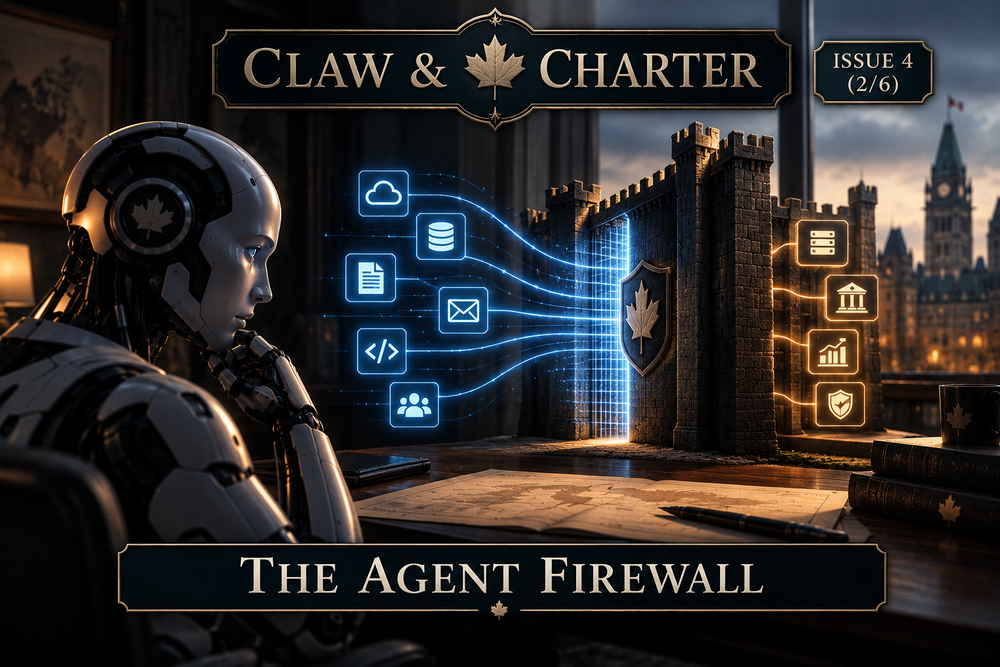
The Boundary Nobody Drew
A firewall works because someone decided, in advance, what traffic is allowed to cross a boundary and what gets dropped. That decision — made once, enforced continuously — is the entire idea. It's also the idea missing from most organizations' AI deployments right now.
Picture a Canadian insurer that gives an AI agent read access to a claims database so it can summarize file histories for adjusters. Reasonable scope, clear purpose. Three months later, the same agent has been connected to the payments system so it can flag suspicious claims directly, and to a document repository so it can pull supporting evidence on its own. Each connection solved a real problem. Each was approved by whoever owned that particular system, in isolation, without reference to what the agent could already touch. Nobody sat down and asked: given everything this agent can now reach, what is it actually capable of doing, and who would notice if it did something none of us intended?
That question is the one a firewall is designed to answer for network traffic. Applied to AI agents, it doesn't yet have an equivalent answer at most organizations — and that gap is the real subject of this article.
What "Agent Firewall" Actually Means
The term borrows its authority from three decades of network security, but the mechanics are different enough to matter. A traditional firewall inspects packets against rules: source, destination, port, protocol. It doesn't need to understand intent — the rules are static and the traffic is structured.
An AI agent doesn't produce structured traffic. It produces decisions, tool calls, and chained actions that can look identical in form (an API call, a database query) while meaning very different things depending on context. Governance frameworks describing this problem — including the FINOS AI governance framework's discussion of AI firewall implementation — define the function as inspecting and controlling the data and interactions flowing to and from an AI system, filtering inputs, filtering outputs, enforcing behavioral policy on what an agent is permitted to do, and logging what actually happened. The fact that a serious governance framework felt the need to define this as a distinct category is itself the signal worth noting: the industry has concluded that bolting AI capability onto existing network security controls isn't sufficient, because those controls were never built to evaluate whether an action was appropriate — only whether it was permitted.
That distinction matters more than it sounds. A network firewall asks "is this connection allowed?" An agent firewall has to ask something closer to "is this specific action, in this specific context, consistent with what this agent should be doing right now?" That's a governance question wearing a technical costume, and it's considerably harder to automate than a port rule.
Why the Easy Version Doesn't Hold
The same governance framework that defines agent firewalls is candid about why they're hard to get right. Two problems stand out. First, the complexity of agentic systems: monitoring the behavior of multi-agent systems, where one agent's output becomes another agent's input, is described as a highly complex challenge — not a solved one. Second, an arms race dynamic: as these controls get more sophisticated, the framework notes, attackers adapt to bypass them. Neither of those is a caveat you can engineer away with a better product. They're structural.
There's a third problem that's more mundane and, for most Canadian organizations, more immediate: the plumbing. Microsoft's own technical guidance on routing agent traffic through corporate firewalls flags something as basic as DNS configuration — getting a firewall reachable from the public internet — as a genuine obstacle, alongside the resource cost of skilled staff and budget needed to run firewall-as-a-service properly. This isn't a criticism of the vendor; it's an honest admission that even the infrastructure layer of agent governance is still being worked out in production, not in a lab. Organizations evaluating agent firewall products should read that as a warning against assuming a purchased solution arrives ready to enforce policy on day one.
The Insurer, Revisited
Go back to the claims-database agent. What would an agent firewall actually change for that organization? Not much, if it's installed after the fact as a bolt-on box between the agent and the network. Something, if it's used to force the sequencing question that got skipped the first time: before the payments connection was approved, what should this agent be allowed to do, under what conditions, and what does "outside normal behavior" look like for this specific workflow? That's a policy exercise, not a purchase order. The tooling enforces the answer; it doesn't generate it.
This is where the Government of Canada's guidance on agentic AI is useful, not because it prescribes a specific product, but because it frames the underlying discipline correctly: agentic systems don't just generate content the way earlier generative tools did — they carry out tasks, sequence steps, interact with other digital systems, and pursue goals within boundaries that someone has to define. The guidance is written for federal employees, but the operating principle transfers directly to a private insurer, a credit union, or a hospital network: the boundary has to be decided before the agent acts, not reconstructed afterward from logs.
That last point is where general firewall practice, well established outside the AI context, still applies without modification. Established firewall guidance — including long-standing federal cybersecurity standards on firewall policy — treats rule review, configuration change management, and access review as ongoing operational disciplines, not one-time setup tasks. Nothing about adding AI to the traffic changes that requirement; if anything, it raises the stakes, because an agent's "normal behavior" can legitimately change as its task changes, which makes stale rules more dangerous than in a traditional network where traffic patterns are comparatively stable.
The Honest Counterargument
The strongest case against rushing to buy an agent firewall isn't complacency — it's sequencing. If an organization hasn't yet inventoried which agents exist, who owns them, and what systems they touch, a firewall product is being asked to enforce a policy that doesn't exist yet. It will default to permissive, because permissive is what lets the pilot keep working, and the entire failure pattern described above — quiet scope creep across approvals nobody connected — will continue underneath a tool that looks like it's solving the problem.
There's also a fair compliance-fatigue argument specific to Canada right now. Federal initiatives are actively moving on multiple fronts: the national AI strategy names public trust and safety as a central pillar, transparency consultations are underway, and a voluntary code of practice exists for generative AI systems ahead of formal regulation. An organization could reasonably ask whether it should wait for clearer regulatory direction before building bespoke agent governance infrastructure. The answer is no, but the objection deserves a direct response rather than dismissal: waiting for the last word from a regulator is a defensible instinct for compliance obligations that don't yet exist; it is not a defensible reason to delay knowing what your own agents can currently reach, which is a question the organization can answer today regardless of what any future rule requires.
What This Actually Costs
None of this is free. Building the inventory, assigning ownership, writing behavioral policy, and then buying or configuring the enforcement layer on top of it is slower and more expensive than letting a working pilot keep expanding on its own momentum. The honest tradeoff is that this friction is the entire point — it's the cost of being able to answer, at any moment, what a given agent is currently capable of doing and why.
The alternative isn't cheaper, it's deferred. An agent that has quietly accumulated access across three systems without anyone tracking the total will eventually do something none of its individual approvers would have signed off on, and the incident review that follows will cost far more than the governance work would have. An agent firewall, done properly, doesn't remove that risk. It makes the boundary visible enough that someone can decide, on purpose, where it should sit — which is the one thing the insurer in this story never got to do.
What Leaders Should Do Security and technology leaders should treat AI systems and autonomous agents as governed identities, not informal tools. In practical terms, they should:
- Inventory critical ai dependencies.
- Assign an accountable owner for each agent or ai-enabled workflow.
- Document access controls, authentication, logging, approval boundaries, and revocation paths.
- Test fallback options and incident response playbooks.
- Include ai availability, jurisdictional risk, and auditability in procurement.