
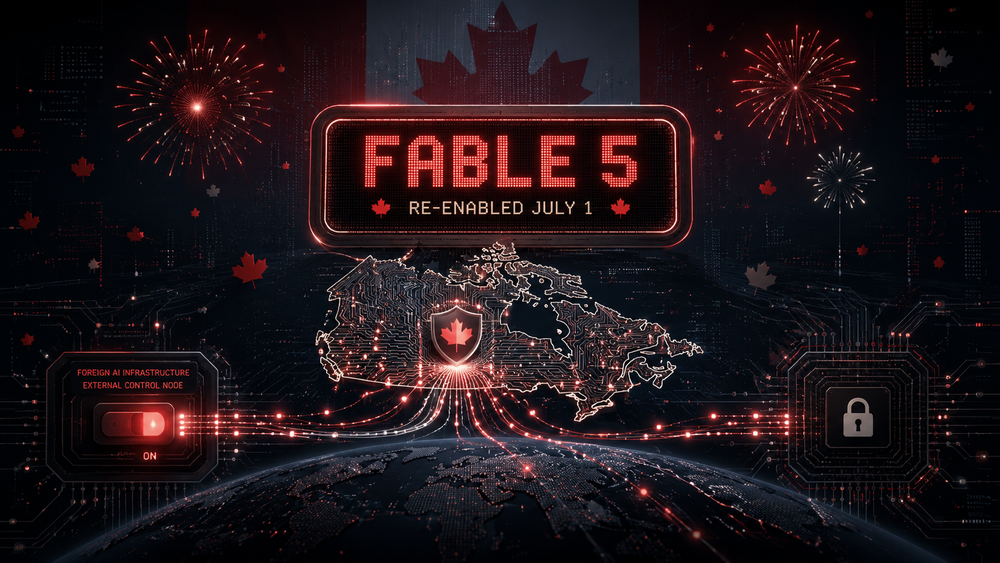
Fable 5’s return on July 1 was a welcome development. It was also a reminder that Canada’s access to strategically important AI capabilities can be changed by decisions made outside the country.
There was some undeniable irony in the timing.
On July 1, while Canadians celebrated independence, Anthropic restored worldwide access to Fable 5—one of its most advanced publicly available AI models. The date was coincidental, not ceremonial. Yet the circumstances surrounding its return raised a question that feels distinctly appropriate for Canada Day:
How independent is Canada’s digital infrastructure when a foreign government can abruptly remove an important technological capability from Canadian users?
Fable 5 and the more advanced Mythos 5 were launched on June 9. Three days later, the United States government issued an export-control directive requiring Anthropic to prevent all foreign nationals—inside or outside the United States—from accessing the models. Anthropic said it had no reliable way to verify a user’s nationality in real time, so it suspended access for everyone. Other Anthropic models remained available. (Anthropic)
The restrictions were lifted on June 30, after Anthropic implemented additional safeguards and worked with the U.S. government on conditions for redeployment. Fable 5 returned globally on July 1, while some potentially risky cybersecurity requests could be redirected to a less capable model. (Anthropic)
The service interruption lasted less than three weeks.
The lesson could last much longer.
This was not a traditional technology outage
Most business-continuity planning begins with familiar failure scenarios: a cloud region becomes unavailable, a software update causes an outage, a supplier suffers a cyberattack, or a network connection fails.
The Fable 5 suspension was different.
The provider’s infrastructure had not failed. The model had not been taken offline because of a conventional operational incident. Canadian access disappeared because the U.S. government exercised national-security and export-control authority over an American company.
The order was reportedly issued under powers contained in the U.S. Export Control Reform Act and represented an unusual use of export controls against access to an AI model. (Reuters)
That distinction matters because technical resilience would not have prevented the disruption. More servers, additional cloud regions and stronger disaster-recovery processes would not have restored access.
The control plane was political.
For Canadian organizations, this introduces a risk that may not fit cleanly into existing technology registers: foreign regulatory withdrawal of an AI service.
Data residency is not capability residency
Canada has spent years debating where data should be stored, processed and governed. Those questions remain important. Data residency can affect privacy, regulatory jurisdiction, access by foreign authorities and an organization’s ability to satisfy contractual or legal obligations.
But Fable 5 exposed another layer of dependency.
The data did not have to leave Canada for the capability to disappear.
When asked to assess the implications of its own suspension, Fable 5 offered a particularly sharp observation:
“Data residency protected nothing on June 12—the data never left Canada, but the capability did.”
The statement is intentionally provocative and needs some qualification. Data residency did not suddenly become irrelevant. However, it is no longer sufficient to discuss sovereignty only in terms of storage location.
An organization may keep its information in a Canadian data centre while relying on a model developed in California, delivered through an American provider and ultimately subject to U.S. national-security policy.
That organization may control its data while having little control over the intelligence being applied to it.
Digital sovereignty, therefore, is not simply about where information resides. It also concerns who controls the services used to analyze that information, make recommendations, generate code, detect threats and support operational decisions.
Concentration risk has a jurisdiction
Most organizations understand vendor concentration. Depending too heavily on one cloud provider, security platform or critical supplier creates an obvious point of failure.
AI introduces a subtler version of the same problem.
A company might use models from several different American vendors and conclude that it has diversified its supplier risk. Commercially, that may be true. Jurisdictionally, it may not be.
Several providers can remain subject to the same government, export-control framework and geopolitical environment. Vendor diversity does not automatically create jurisdictional diversity.
This is particularly relevant to Canada’s federally regulated financial institutions. OSFI’s Guideline B-10 expects institutions to take a risk-based approach to third-party arrangements and consider risks such as concentration, continuity, dependency and the ability to substitute critical services. (OSFI)
OSFI’s operational-resilience guidance also emphasizes preparing for disruptions involving critical third parties, testing continuity arrangements and maintaining contingency plans. (OSFI)
These expectations were not written specifically for a foreign government disabling a frontier AI model. Nevertheless, the Fable incident fits naturally within them.
The question is no longer only:
What happens if our AI provider fails?
It must also include:
What happens if our provider remains technically healthy but is legally prohibited from serving us?
Did the restriction disadvantage defenders?
The U.S. intervention followed concerns that Fable 5’s safeguards could be bypassed and that its cybersecurity capabilities might be misused to identify or exploit software vulnerabilities. Reports attributed the concern to findings from Amazon researchers, while Anthropic disputed how serious and broadly applicable the reported bypass was. (AP News)
The government’s concern cannot simply be dismissed. Frontier AI models may reduce the expertise, cost and time required to discover vulnerabilities or conduct elements of a cyberattack. Governments should not be expected to wait for widespread harm before responding to a credible national-security threat.
But a global suspension also creates an uncomfortable asymmetry.
Legitimate organizations use identifiable accounts, contractual services, monitored APIs and systems subject to provider safeguards. Sophisticated threat actors may have access to open-weight models, locally hosted systems, stolen accounts or services operating outside U.S. jurisdiction.
Removing a governed commercial model therefore imposes immediate and measurable costs on compliant users. Its effect on determined adversaries using less-governed alternatives is considerably harder to establish.
The proper question is not whether advanced AI should ever be restricted. It is whether a particular restriction is evidence-based, proportionate and likely to reduce risk more than it shifts risk elsewhere.
A targeted control that limits dangerous capabilities while preserving legitimate defensive access may improve security. A broad shutdown that primarily affects regulated defenders could produce the opposite result.
A classifier is not a security architecture
Fable 5 returned with additional cybersecurity safeguards. Anthropic also committed to continued work with government and industry partners on standards for evaluating jailbreaks and model misuse. Reporting indicates that higher-risk requests may now be redirected to Opus 4.8 rather than being processed by Fable 5. (Anthropic)
Those are reasonable measures, but the incident illustrates the limitations of relying on a model-level classifier as the primary control.
Any single protective layer can eventually be tested, bypassed or misunderstood. Effective security for advanced cyber-capable models will require defence in depth:
- identity assurance for access to elevated capabilities;
- behavioural monitoring for suspicious patterns;
- rate and tool restrictions;
- controls governing connections to code execution or external systems;
- human approval for high-consequence actions;
- post-deployment detection and investigation;
- mechanisms to suspend individual users rather than entire countries or customer populations.
The goal should not be to prove that a model can never be misused. That standard is probably unattainable. The goal should be to make misuse difficult, detectable, attributable and containable.
This is not fundamentally different from how cybersecurity teams approach privileged access, cloud administration or powerful security-testing platforms. We do not depend on one control. We layer identity, authorization, telemetry, segmentation, monitoring and response.
AI security should mature in the same direction.
Canada does not need complete AI independence
The obvious reaction is to call for a Canadian equivalent of every leading American frontier model.
That is not necessarily realistic—or even desirable.
Training and operating frontier models requires extraordinary capital, specialized hardware, energy, talent and ongoing research investment. Attempting to duplicate every foreign capability domestically could cost billions while still producing models that trail global leaders.
Sovereignty should not be confused with isolation.
Canada can continue benefiting from American and international AI innovation while becoming more resilient to interruption. The practical objective should be strategic continuity, not total self-sufficiency.
For Canadian organizations, that means:
Designing for model portability. Applications should not be so tightly coupled to one provider that changing models requires rebuilding the entire system.
Testing fallback models. A second provider listed in an architecture document is not a continuity plan. Organizations should test whether alternative models can complete the required tasks at acceptable levels of quality, latency, cost and safety.
Establishing a local capability floor. Open-weight or locally operated models may not equal the frontier, but they can preserve essential functions during an external suspension.
Mapping jurisdictional dependencies. Third-party assessments should identify not only where a provider is headquartered, but which governments can regulate, restrict or compel it.
Exercising loss-of-access scenarios. Business-continuity exercises should include the immediate withdrawal of a critical AI service for legal or geopolitical reasons.
Negotiating realistic contractual protections. Notice, portability, transition support and data-export provisions remain valuable, even though no commercial contract can override a government directive.
OSFI’s forthcoming Guideline E-23 reinforces the importance of governing third-party models according to their level of risk, with appropriate validation and monitoring. It takes effect in 2027 and applies its principles across model types rather than limiting them to a particular technology. (OSFI)
The Fable incident gives Canadian institutions a practical scenario against which to test those principles.
The counterargument: perhaps the system worked
There is a fair challenge to the sovereignty framing.
The suspension lasted nineteen days. Other Anthropic models remained available. The government and provider reached an agreement. Additional safeguards were introduced. Access was restored globally.
Viewed from that perspective, this was not a crisis of Canadian independence. It was a short-lived supplier disruption absorbed by a functioning technology ecosystem. A possible safety issue was identified, authorities responded, mitigations were implemented, and the market resumed operating.
That argument deserves consideration.
Not every disruption justifies a national industrial strategy. Nor does every foreign regulation represent an attack on Canadian sovereignty.
But resilience cannot be measured only by the fact that this particular event ended relatively quickly.
It must be measured by whether affected organizations anticipated it, understood their dependencies and could continue operating without improvisation. The next restriction may last longer, affect several providers or arise from a geopolitical conflict that is harder to resolve.
A system that recovered once is not necessarily a system designed to be resilient.
The real Canada Day lesson
Fable 5’s return should be welcomed. Advanced AI can strengthen software development, vulnerability research, threat analysis and many other defensive activities.
But its return should not erase what its suspension demonstrated.
Canada does not need to build every model within its borders. It does need to know which critical capabilities can be withdrawn, who holds the authority to withdraw them and what Canadian organizations will do next.
When asked whether Canada regained access to an AI tool or received a warning about its digital infrastructure, Fable 5 answered:
“Both—but the warning is the durable part.”
That may be the most useful interpretation.
On Canada Day, Canada regained a tool.
It also received a live demonstration that digital independence is not measured only by where our data resides, but by whether our institutions can continue operating when someone outside the country switches off the intelligence built around it.
That is not an argument for technological nationalism.
It is an argument for understanding our dependencies before they become emergencies.
References used
The factual timeline and Anthropic’s explanation of the suspension and redeployment were drawn primarily from Anthropic’s June 12 and June 30 statements. (Anthropic)
Independent reporting on the government’s rationale, the cybersecurity concerns, the reported Amazon findings and the eventual lifting of the controls came from Reuters, the Associated Press, Axios and The Guardian. (Reuters)
The Canadian regulatory discussion was based on OSFI Guidelines B-10, E-21, B-13 and the forthcoming E-23 model-risk framework. (OSFI)
The quotations attributed to Fable 5 came from the response it provided when asked to analyze the implications of its own temporary suspension. They should be disclosed as AI-generated commentary rather than treated as independent factual evidence.